Standard security cameras are excellent for monitoring people, entrances, parking areas, and general activity around a property. However, when a business needs to identify vehicles accurately, a conventional surveillance camera may not always provide enough detail.
License plates create a unique technical challenge. Vehicles move quickly, headlights produce glare, plates reflect light, and nighttime conditions can make characters difficult to read. A camera that provides a clear overview of a parking lot may still produce an unreadable plate when a vehicle passes through the frame.
This is where specialized LPR cameras become valuable. They are designed specifically to capture vehicle plates under conditions that can challenge general-purpose surveillance equipment.
For commercial properties, gated communities, warehouses, parking facilities, and other locations with regular vehicle traffic, understanding when LPR technology is appropriate can help create a much more effective security system.
Why Regular Security Cameras May Miss License Plates
A common assumption is that installing a high-resolution camera automatically guarantees readable plates.
In reality, resolution is only one factor.
A conventional camera may capture a vehicle clearly enough to identify its color, type, and direction of travel while still failing to capture the plate characters.
Vehicle speed can cause motion blur. Strong headlights may affect exposure. Reflective plates can appear extremely bright under infrared illumination. Wide camera angles can make plates occupy only a very small portion of the image.
These factors explain why businesses that specifically need vehicle identification often require cameras configured for that purpose.
What Makes an LPR Camera Different?
LPR cameras are optimized to capture license plates rather than simply provide general surveillance.
They may use specialized exposure settings, shutter speeds, infrared illumination, lenses, and image processing to improve plate visibility.
Some systems go beyond capturing an image and can automatically identify plate characters.
This License Plate Recognition capability can help businesses create searchable records of vehicles entering or leaving a property, depending on the equipment and software being used.
Instead of manually reviewing hours of video, authorized users may be able to search recorded plate data to investigate vehicle activity more efficiently.
Entry and Exit Points Are Ideal Locations
LPR systems perform best when vehicle movement can be predicted.
This makes controlled entrances and exits particularly valuable camera locations.
A parking garage entrance, gated community access road, warehouse driveway, or commercial property gate gives installers an opportunity to position cameras where vehicles pass through a defined area.
Trying to capture plates across an entire open parking lot is more difficult because vehicles may appear at different distances, speeds, and angles.
A dedicated capture point allows the camera to be optimized around a smaller and more predictable zone.
Camera Angle Has a Major Impact
Plate capture depends heavily on geometry.
If a camera is positioned too far to the side, the license plate may appear at an extreme angle. Mounting too high can create another difficult viewing angle.
The best position depends on the driveway and site layout.
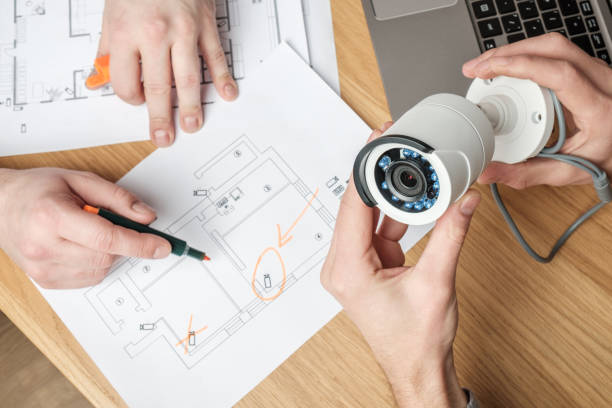
Installers need to consider how vehicles approach the camera, how quickly they travel, and how much of the image the license plate occupies.
The objective is different from general surveillance.
A wide overview camera might monitor an entire entrance, while a dedicated LPR camera focuses tightly on the area where plates become visible.
Using both cameras can provide better context than attempting to make one camera perform both jobs.
Vehicle Speed Matters
A vehicle moving through a parking garage at five miles per hour is much easier to capture than one traveling quickly along a roadway.
Higher speeds require more careful configuration.
Shutter speed becomes particularly important because a slow exposure can result in motion blur.
Businesses should therefore explain expected vehicle speeds during system planning.
Speed bumps, gates, stop signs, or controlled entrances can sometimes create better capture conditions by naturally slowing vehicles.
The physical layout of the property can be just as important as the camera specifications.
Nighttime Capture Requires Specialized Planning
License plates can become particularly difficult to capture after dark.
Vehicle headlights create bright points within an otherwise dark scene. Reflective license plates may also react strongly to infrared illumination.
A conventional camera may expose the image for the surrounding environment, causing the plate to appear excessively bright or unreadable.
Specialized LPR cameras can be configured differently.
Rather than prioritizing a visually attractive image of the entire scene, they may prioritize plate readability.
The surrounding vehicle or environment may appear darker, but the information the system was designed to capture remains more useful.
This is why nighttime testing should always be included when LPR is a security requirement.
Parking Facilities Can Benefit From Vehicle Records
Commercial parking facilities handle a constant flow of vehicles.
When an incident occurs, identifying which vehicles entered or exited around a particular time can provide valuable investigative information.
For example, management investigating property damage may need to review vehicles present during a specific period.
LPR technology can potentially make this process faster by providing searchable vehicle information rather than requiring staff to manually examine every passing car.
The system should still be designed around the specific property, traffic flow, storage requirements, and applicable privacy policies.
Warehouses and Distribution Centers Have Different Needs
Warehouses often receive employees, vendors, contractors, delivery drivers, and commercial vehicles throughout the day.
Vehicle identification can provide another layer of visibility around entry points.
An LPR system can help document vehicles arriving at or leaving the facility.
When combined with traditional surveillance, loading dock cameras, and access control, this can create a more complete record of activity.
For example, standard cameras may show what occurred at a loading area while LPR cameras provide information about the vehicle associated with that visit.
The technologies perform different roles but can complement one another.
Gated Properties Are Strong Candidates
Controlled communities, private facilities, and gated commercial properties can also benefit from plate-focused surveillance.
Vehicles already pass through predictable access points, creating ideal conditions for dedicated capture cameras.
Depending on the system, plate information may be used as part of security review or vehicle management.
Some advanced platforms may also support lists of authorized or flagged plates.
However, businesses should establish clear policies governing who has access to this information and how long vehicle records are retained.
Security capabilities should always be supported by responsible data management.
LPR Does Not Replace General Surveillance
One of the most important planning principles is understanding that an LPR camera usually performs a specialized role.
It should not necessarily replace an overview camera.
Imagine a vehicle entering a commercial property.
The LPR camera may capture the plate very clearly, but its narrow field of view might provide limited context about the vehicle’s occupants or surrounding activity.
A separate overview camera could show the entire vehicle, direction of travel, and nearby environment.
Using both perspectives gives investigators more information.
This layered approach is often more effective than expecting one device to capture every possible detail.
Lighting and Weather Need Consideration
Real-world surveillance environments change constantly.
Sunrise and sunset can create strong glare. Rain can affect visibility. Dust may collect on outdoor camera housings. Shadows change throughout the day.
Arizona properties also experience intense sunlight and heat, which should be considered when choosing outdoor equipment and installation locations.
Regular maintenance matters as well.
A camera lens that becomes dirty may continue recording while gradually producing lower-quality images.
Periodic inspection helps ensure that plate capture remains reliable rather than simply confirming that the camera is online.
Storage Requirements Should Be Planned in Advance
Businesses need to decide how long they want to retain video and plate information.
A retail parking facility may have different retention needs from a gated industrial site.
Storage requirements depend on the number of cameras, resolution, recording settings, traffic volume, and software platform.
Businesses should also consider how quickly incidents are typically discovered.
If a problem is often reported several weeks after it occurs, very short retention periods may make the surveillance system less useful.
These requirements should be established before installation.
Integration Can Make LPR More Valuable
License plate cameras become even more useful when they are part of a broader security environment.
Traditional CCTV can provide general property awareness. Access control can manage doors and gates. Video analytics can identify activity in specific areas.
LPR adds vehicle identification.
When properly integrated, these different technologies can provide complementary information during an investigation.
For businesses operating multiple locations, centralized management may further improve efficiency by allowing authorized security personnel to review vehicle activity and surveillance from one environment.
Know When LPR Is Worth the Investment
Not every property needs specialized license plate cameras.
A small office with minimal vehicle traffic may receive more value from improving entrance and parking lot coverage with conventional cameras.
LPR becomes more compelling when vehicle identification has a clear operational or security purpose.
Properties with controlled entrances, repeated vehicle-related incidents, high-value assets, gated access, parking operations, or significant delivery traffic are stronger candidates.
The decision should begin with a simple question: If an incident occurred tomorrow, would knowing which vehicle entered or exited the property provide meaningful information?
If the answer is yes, dedicated plate capture may be worth considering.
Build the System Around the Security Objective
Effective LPR deployment requires more than purchasing a camera labeled for license plate capture.
Vehicle speed, camera angle, distance, lighting, nighttime conditions, lens selection, storage, network infrastructure, and software configuration all influence performance.
The best systems are designed around a specific capture point and tested under realistic conditions.
Businesses should verify performance during daylight and at night, with different vehicles moving through the intended path.
When properly designed, an LPR camera can provide information that standard surveillance cameras may struggle to capture consistently.
For properties where vehicle identification plays an important role in security or investigations, adding dedicated plate capture can transform a basic camera system into a more useful security tool that provides both visual awareness and specific vehicle data.